
Treat the Cause, Not Just the Symptoms
SoftWave is a form of shockwave therapy. Looking for shockwave therapy in Fort Collins? Here is what SoftWave is, what it costs and what to expect, in plain words. At MRT, SoftWave is one part of a plan for your pain, not a stand-alone fix.
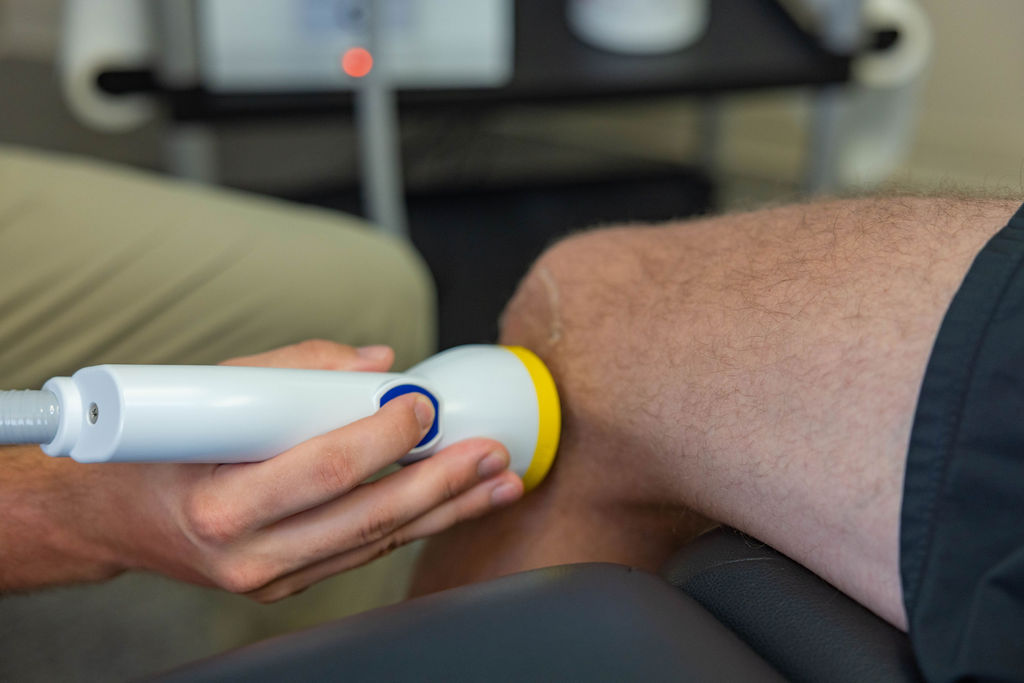
SoftWave is a form of shockwave therapy. It is a non-invasive acoustic wave treatment. A hand-held applicator sends gentle waves into the tissue under it. There is no needle, no drug and no downtime.
Most shockwave devices send their energy to one narrow point, or scatter it near the surface. SoftWave is built differently. Its patented reflector spreads the wave broadly and deeply across the whole treatment area, so more tissue gets the signal with each pulse. That broad pattern is why we chose SoftWave over other shockwave devices.
People come to us for:
Not on the list? That is fine. Ask us and we tell you straight whether SoftWave fits your case.
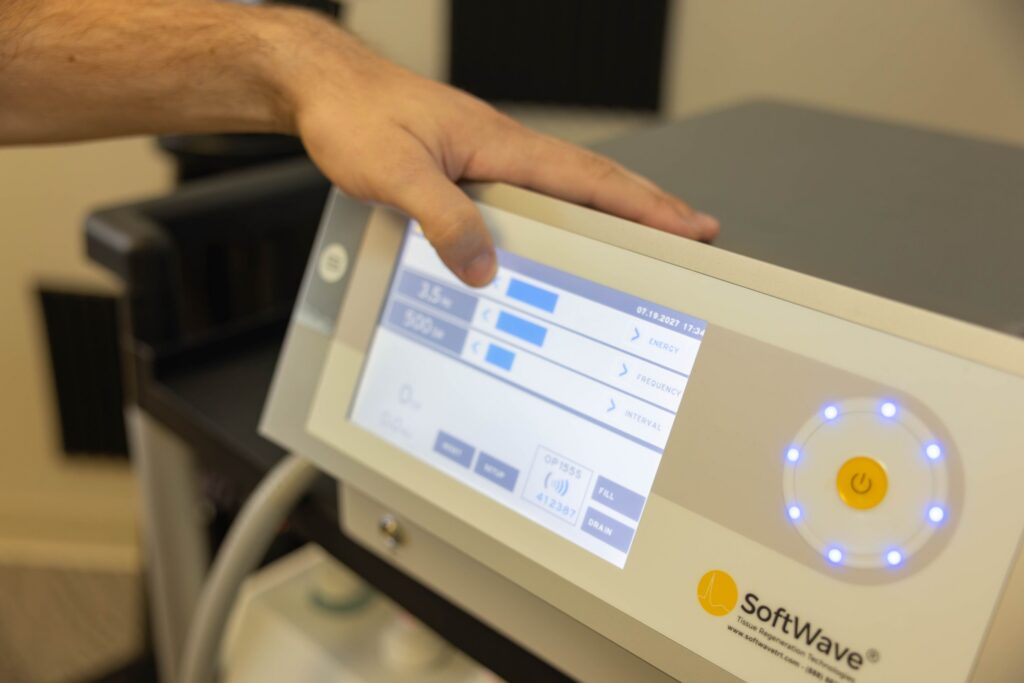
SoftWave is a form of shockwave therapy. What’s different at MRT is that we match the treatment to you. For some people, SoftWave on its own is the right call. For others, we combine it with Class IV laser, spinal decompression, PEMF or hands-on Muscle Restoration Therapy to get the best result.
Your first SoftWave visit is $99.
SoftWave is an established device used by clinics across the country. It helps many people. It does not help everyone, and we will not tell you otherwise. We do not quote percentages or promise results.
What matters is where it is used and why. SoftWave can support your body’s own healing response in the tissue. At MRT we use SoftWave as one part of a plan for your pain, not a stand-alone fix.
Where it hurts is rarely where the problem starts. When muscles stop working correctly, other muscles take over and the tissue under them takes the load. That is muscle dysfunction, and it is what Muscle Restoration Therapy works on.
Rest, stretching and a series of treatments on the sore spot help many people. If the muscles do not change, the pain often comes back. Your SoftWave plan is built around you, not around the device.
Shockwave therapy often runs $200 to $300 a session. Your first SoftWave visit with us is $99. From there we build the SoftWave treatment plan that fits your situation. We work to keep our rates well below the market average, and we only recommend the plan that makes sense for you.

 Steve Carrier
Trustindex verifies that the original source of the review is Google.
I trashed my back playing golf and was literally crippled for 2 weeks when a friend recommended Mark at MRT. Although skeptical I knew the normal choices, doctor, PT or chiropractor would not solve the problem so I made an appointment and met with Mark. Within 3 weeks I was out of pain and after 6 weeks the problem was solved. My issue was severe so it took some time to get over it. I’m glad I went and you will be too. I highly recommend MRT for chronic pain. Lasha GuillenI've had several sessions with Mark and have already seen a significant improvement in my pain management. I feel like I'm on the path to recovery! I really appreciate his depth of knowledge and taking time to explain things. And, everyone at the office is so friendly and helpful!
 Claire Van HullI absolutely recommend Mark Rise at Muscle Restoration Therapy! I love running but hadn’t been able to run for over 10 months. After getting an MRI, I was told I might have a joint disease, which was discouraging. I went to see Mark ONE time, and after evaluating my knee and body, he gave me specific exercises using a power massager. I started them right away, and within 2 weeks I was able to complete my first 3-mile run completely pain-free. Now I’m back to running 4–5 days a week! I’ve continued doing the exercises Mark gave me, along with red light therapy at MRT twice a week, and my progress has been incredible. I can’t thank Mark enough for helping me get back to something I love. Highly recommend!
 Zachary YarbroughMark and the team at Muscle Restoration are excellent! I came in with back pain that was difficult to diagnose, and Mark was patient and took the time to understand the root problem. He worked to get my back feeling better, not only through skilled care, but also by educating me. He helps you learn how to address back problems at home so that you stay healthy in the long run. So grateful for his care and expertise! I have already recommended Mark to several other people!
 Ann PI had what I called “leg-butt” and Mark tested me, advised me in what I need to do and it took care of the pain. Now what I need to do is a part of my daily routine and have remained pain free. I so appreciate Mark and the help he has given me. Thanks!
 Jeanette GulderWorking with Mark, Craig, and Jonah has been a great experience for me. They have helped me to feel better and be at my best. I have less pain and improved flexibity. Bonus, I sleep better as well. Give them a try you will enjoy the results! I have been taking Algae Cal Plus & Strontium Boost for 6 months my doctor was impressed with my big improvement. I hope more people will try these products, they work! JRG
 Mark ChapmanMark is a genius I say! By far the best I’ve ever had. Really knows his stuff ! Fixed me physically and mentally as far as my back is concerned! Had good advice and the only one that wanted to watch me load and unload my equipment. Gave me an exercise routine that I do in a chair that you wouldn’t even know I’m doing for the most part. Others only told me to get new job!
 Matt ThompsonThe team at MRT are fantastic. From the day you start with them you can immediately see & feel their passion to help you get better. They talk you through everything they are doing & empower you to do your homework and see the results. When my back proved to be more stubborn than initially diagnosed they added in the SoftWave therapy and that was an awesome decision! Several areas in my back began to respond so quickly to this treatment. This is a committed group of health professionals!
 Manny CheemaAt 14 years old, I was struggling with Osgood-Schlatter disease and thought I’d be stuck wearing orthotics for the rest of my life. That’s when I met Mark from Muscle Restoration, and he completely changed my perspective on healing. His techniques didn’t just mask the pain—they actually fixed the problem. I was blown away. Nearly a decade later, I came back to Mark with a shoulder injury, and once again, he worked his magic. His expertise is unmatched, and his dedication to truly helping people is even more impressive. Amazing service, even better man. Recommended 11/10 Ps. The new office is amazing!
Fort Collins is an active town, and overuse pain is common here:
Sound like you? You do not have to accept it. Come in and find out what is causing yours.
Searching for shockwave therapy near me? We are at 4532 McMurry Ave, Suite 204, in the 80525 area of Fort Collins, and some clients also come to us from Loveland and Windsor.
SoftWave is a non-invasive acoustic wave treatment. A hand-held applicator sends gentle waves into the tissue under it, with no needle, no drug and no downtime. At MRT it is one part of a plan, not a stand-alone fix.
It helps many people, not everyone, and we do not quote percentages. SoftWave can support your body’s own healing response in the tissue. At MRT it is one part of a plan for your pain, not a stand-alone fix. Your $99 first SoftWave visit is with our practitioners. A consult with our clinical lead is a different first visit. Ask our front desk which fits you.
SoftWave is an established device used by clinics across the country. What matters is how it is used. At MRT we tell you straight if it fits, and show you the plan and the price before you commit.
SoftWave is a form of shockwave therapy. SoftWave is the shockwave device we use. At MRT it is one part of a plan for your pain, and you hear the plan and the price before you commit.
At MRT, your first SoftWave visit is $99. It includes a discussion of your situation, so we understand what you are dealing with and how to best treat it, plus a full SoftWave treatment. Beyond that, your practitioner explains the plan and the price at your visit, before you commit.
It depends on how long the pain has been there and what is causing it. We walk you through a clear plan at your first visit, so you know what to expect before you start.
People come to us for heel and arch pain, tendon and overuse pain, back pain, knee, shoulder and elbow pain, numbness and tingling, and stiff movement after an injury. Ask us and we tell you straight whether it fits your case.
MRT is a cash-based clinic. We accept HSA/FSA cards, but we encourage you to check with your provider first to confirm coverage. We are happy to provide a superbill for you to submit to your insurance directly, as some providers reimburse. We don’t communicate with insurance providers directly. Ask our front desk for details.
No referral needed. You can book a first appointment directly.
MRT offers SoftWave, a form of shockwave therapy, at 4532 McMurry Ave, Suite 204 in Fort Collins. Our founder has more than 25 years of experience, and our practitioners deliver the SoftWave visits. We have 100+ five-star reviews on Google. Your first SoftWave visit is $99, and we explain the plan and the price before you commit.
If you are searching for shockwave therapy near me in Fort Collins, MRT is at 4532 McMurry Ave, Suite 204, in the 80525 area. We use SoftWave, a form of shockwave therapy, and your first SoftWave visit is $99.
Our clinic is in Fort Collins, in the 80525 area, and clients come to us from Fort Collins, Loveland and Windsor. Find us at 4532 McMurry Ave, Suite 204. Request a first appointment to get started.
Start with a $99 SoftWave visit.
SoftWave works best when it targets the right place. Find out if it fits your pain.
Serving Fort Collins and Northern Colorado at 4532 McMurry Ave, Suite 204.
Feel your best with Muscle Restoration Therapy.
Book a session today and experience the difference. Not sure if we treat your specific issue? Browse our conditions page or reach out below.