Without surgery, cortisone shots, or months of downtime.
Plantar fasciitis or heel pain can make everyday movement, work, training, and sleep harder than it should be. At Muscle Restoration Therapy in Fort Collins, care focuses on identifying what may be driving symptoms – from muscle tension and joint irritation to nerve sensitivity or old injuries – then building a non-invasive plan around comfort, mobility, and function.
If you’ve tried stretching, orthotics, and injections and your heel pain keeps coming back — there’s a reason it hasn’t worked. SoftWave therapy at Muscle Restoration Therapy treats the root cause.
Plantar fasciitis relief usually requires more than stretching the sore spot. MRT looks at heel pain, calf tightness, foot loading, walking patterns, and tissue irritation so plantar fasciitis treatment can be more targeted.
The plantar fascia — the band of connective tissue running from your heel to your toes — has almost no blood flow. When it gets inflamed, your body can’t deliver the oxygen and nutrients it needs to actually heal. The inflammation cools down, you feel better, you go back to normal activity, and it flares right back up.
Most treatments manage that cycle. They don’t break it. That’s why so many people spend months — sometimes years — rotating through the same options with the same result:
- ✗ Orthotics — helps while you’re wearing them, does nothing overnight or barefoot
- ✗ Stretching — useful for mild cases, not enough for chronic plantar fasciitis
- ✗ Cortisone shots — temporary relief that can actually weaken the fascia over time
- ✗ Ice and rest — reduces inflammation temporarily, doesn’t repair anything
- ✗ Surgery — invasive, high-risk, and doesn’t always work
SoftWave uses FDA-cleared acoustic wave technology to trigger your body’s own healing response in tissue that hasn’t been healing on its own. It’s not pain management it’s tissue repair.
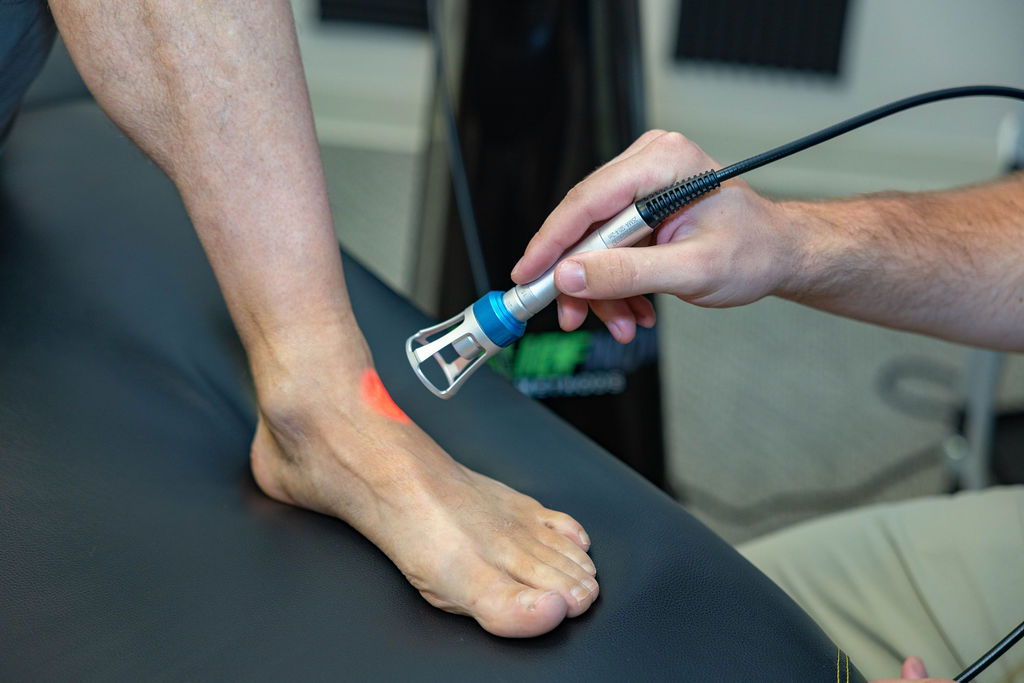
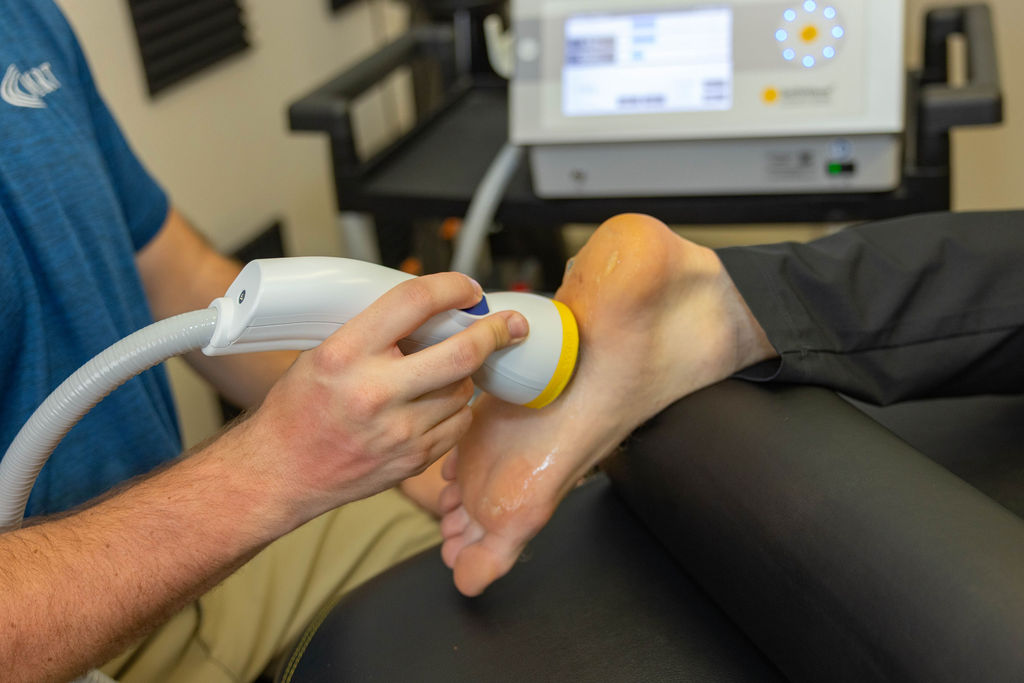
The SoftWave applicator sends acoustic waves through the skin directly into the plantar fascia — no needles, no incisions, no anesthesia.
The waves trigger angiogenesis — new blood vessel growth — fixing the poor circulation that’s been keeping your fascia from healing on its own.
With better blood flow, oxygen, and stem cell recruitment, the fascia genuinely repairs — not a temporary fix that flares back up in a few weeks.
Extracorporeal shockwave therapy for plantar fasciitis has been studied in multiple randomized controlled trials, including research published in the American Journal of Sports Medicine. Patients saw significant improvements in pain and function compared to placebo — and kept improving even after treatment ended.
High mileage, hard surfaces, and repetitive impact are a perfect storm for plantar fasciitis. The plantar fascia absorbs shock with every stride — and when it takes thousands of impacts a day without adequate recovery time, micro-tears accumulate faster than they can heal. Fort Collins has a serious running and hiking community, and this is one of the most common conditions we see in active people pushing their mileage.
Nurses, teachers, retail workers, tradespeople — anyone spending 8+ hours on hard floors. The problem here isn’t intensity, it’s continuous compression. Prolonged standing cuts off the already-minimal blood supply to the plantar fascia. By end of shift it’s inflamed. By morning it’s stiff. Repeat indefinitely.
Tissue heals more slowly with age, and the natural fat pad in the heel thins out from decades of wear and tear — reducing built-in shock absorption. The same activity level that felt fine at 30 can start causing pain at 45 or 55. It’s not weakness. It’s biology. This is why treatments that address the symptoms stop working and something that actively stimulates healing becomes necessary.
Both extremes put abnormal strain on the plantar fascia. High arches concentrate load in the heel and ball. Flat feet cause the arch to collapse with each step, overstretching the fascia repeatedly. Either way, the tissue is being worked harder than it’s built for.
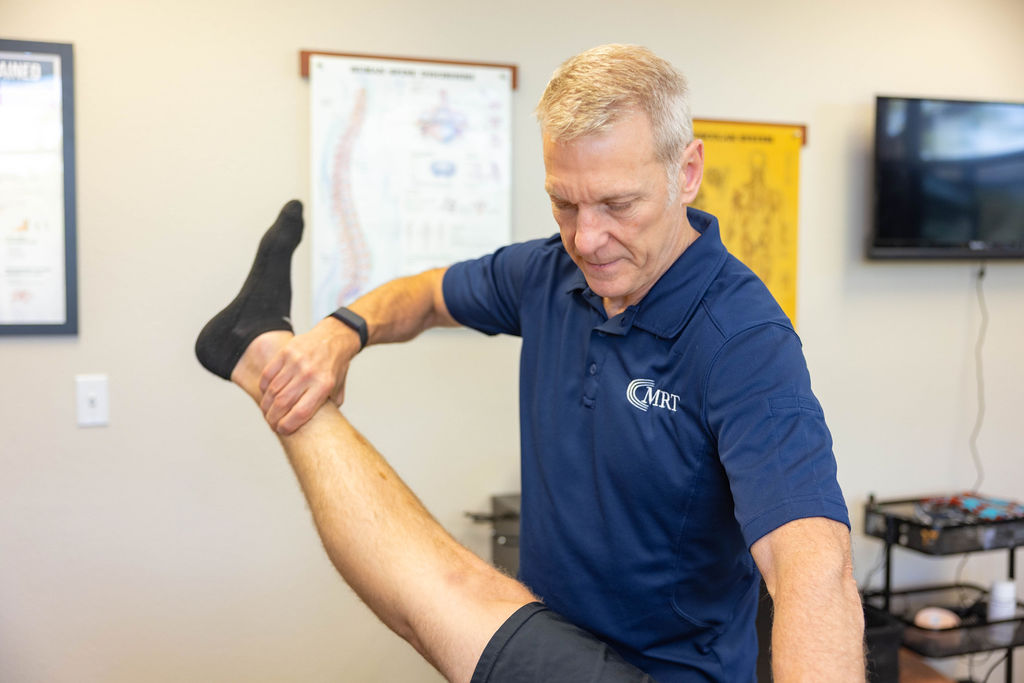
Our SoftWave protocol maps both the foot and the calf. We treat the plantar fascia directly and the referral areas in the lower leg that are feeding the problem. It’s a more complete approach — and it’s why patients who’ve tried everything else start seeing real results here.
One of the most overlooked factors in plantar fasciitis is what’s happening above the foot. The calf muscles — the gastrocnemius and soleus — connect to the heel via the Achilles tendon. When those muscles are chronically tight or inflamed, they pull on the heel constantly, adding stress to the plantar fascia even when you’re completely off your feet.
This is called a referral pattern. It’s why some people stretch their foot religiously and still wake up with the same pain every morning. They’re treating the symptom while the tension driving it is coming from higher up the chain.
| Treatment | Treats Root Cause | Lasting Relief | No Downtime | No Surgery or Needles |
|---|---|---|---|---|
| Rest & Ice | ✗ No | ✗ No | ✓ Yes | ✓ Yes |
| Stretching | ✗ No | ~ Sometimes | ✓ Yes | ✓ Yes |
| Custom Orthotics | ✗ No | ~ Only while worn | ✓ Yes | ✓ Yes |
| Cortisone Shots | ✗ No | ✗ No | ✓ Yes | ✗ Needles |
| Surgery | ✓ Yes | ~ Variable | ✗ Months recovery | ✗ Surgery |
| SoftWave Therapy MRT | ✓ Yes | ✓ Yes | ✓ Yes | ✓ Yes |
Your first visit starts with a thorough look at your foot and history — how long you’ve had it, what you’ve tried, and where the problem is actually coming from. We map the treatment area and run your first SoftWave session. You walk out the same way you walked in — no restrictions, no recovery time.
Each session is roughly 15 minutes long. We deliver 1,000–1,500 pulses per session and treat whatever we identified as the root cause at your first visit — not just the bottom of your foot. Most patients start seeing meaningful improvement by sessions 3 or 4. Results continue building for weeks after your final session. Every case is different — 12 sessions is our standard protocol but some patients need more to get where they want to be.
You’re a strong candidate if you’ve had plantar fasciitis for more than 3 months, conservative treatments haven’t worked, you want to avoid surgery, or you need to stay active during treatment. Not sure if it’s right for you? Call us at (970) 449-9757 and we’ll tell you honestly before you spend anything.
Fort Collins is an active city. People here run Horsetooth, hike Lory State Park, bike the Poudre Trail, and spend weekends in the mountains. When plantar fasciitis hits, the options have historically been: see a podiatrist, get orthotics, get a shot, and hope. That cycle doesn’t work for most people. MRT is at 4532 McMurry Ave, Suite 204 in Fort Collins. You’ll work with the same team from your first session to your last — people who know your case and track your progress. We serve Fort Collins and surrounding Northern Colorado including Loveland, Windsor, Wellington, and Timnath.
Our SoftWave protocol is condition-specific and includes calf referral zone treatment that most providers skip entirely. You’ll see the same therapists every visit — not a rotating staff at a franchise. There’s no downtime, no recovery restrictions, and no time off work or training. We monitor your pain levels every session and adjust based on how your body responds. If you’re not sure whether we can help, call us at (970) 449-9757 and we’ll tell you straight.
Most patients describe mild pressure or a buzzing sensation. It’s not comfortable the way a massage is, but it’s very manageable. Many people report reduced pain immediately after the session.
Some patients notice relief after their first session. Significant improvement typically shows up by sessions 3–4. The healing process continues for weeks after your final treatment.
Cortisone reduces inflammation temporarily but doesn’t repair tissue — and repeated injections can weaken the plantar fascia. SoftWave stimulates your body to regenerate the tissue itself.
No. Chronic cases often respond very well because the blood flow deficit driving the problem is still there to address.
Most patients continue normal activity throughout treatment. We’ll give you guidance based on your specific situation.
Yes. We have financing options for the 8-session package. Ask about it when you call — (970) 449-9757.
Most clinics use 500 pulses per session. Research on extracorporeal shockwave therapy for plantar fasciitis shows that higher pulse counts produce stronger tissue regeneration responses. We start at 1,000 pulses — up to 1,500 — because the evidence supports it and our patients deserve the full protocol, not a shortened version. Same price, more treatment.
The best starting point is an evaluation. MRT reviews your symptoms, history, movement, and goals so care is based on your body rather than a one-size-fits-all plan.
The number of visits varies by condition, severity, goals, and how your body responds. MRT will help you understand what progress should look like after the first evaluation.
View all conditions we treat at Muscle Restoration Therapy.
Don’t let Plantar Fasciits hold you back from work, hobbies, or sleep. Let’s create a plan that gets you moving again—safely and naturally.
Feel your best with Muscle Restoration Therapy.
Book a session today and experience the difference. Not sure if we treat your specific issue? Browse our conditions page or reach out below.